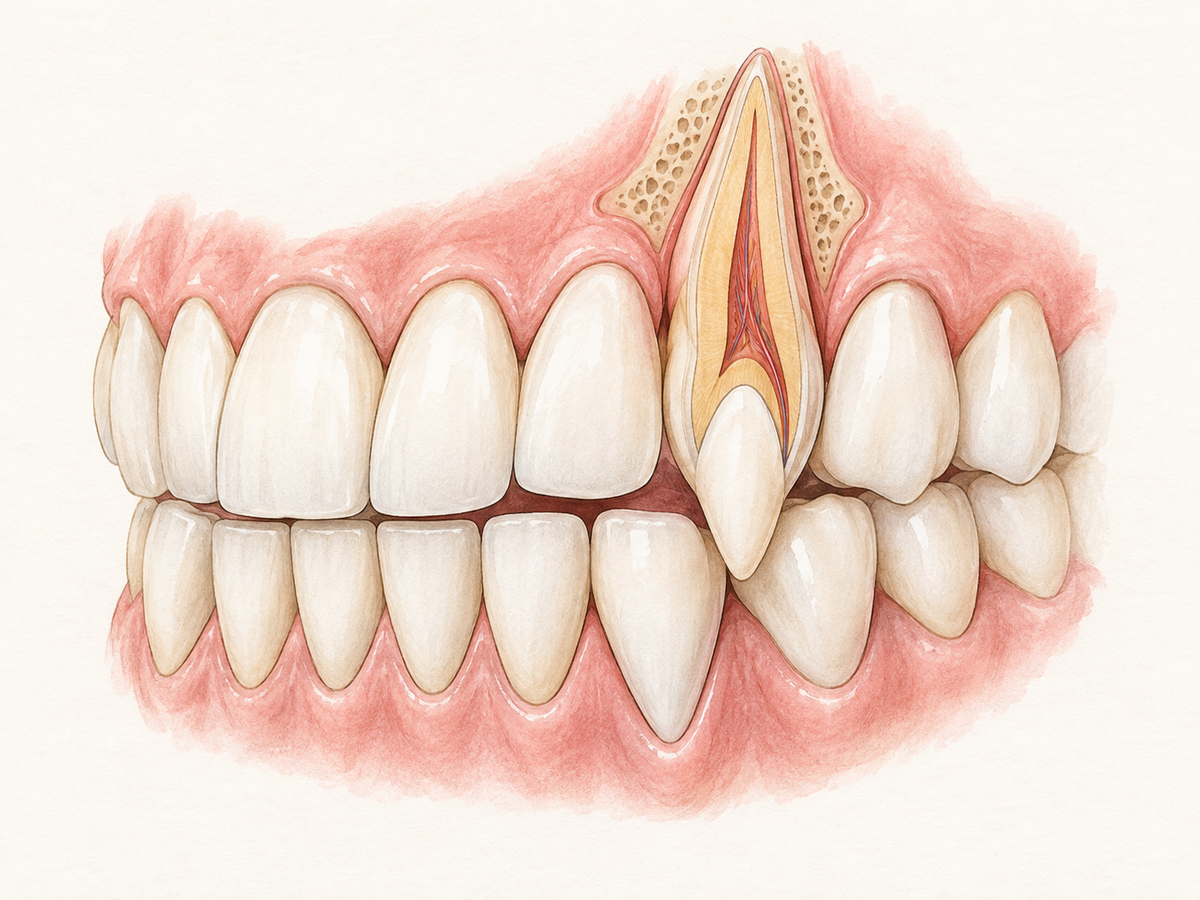
A canine tooth is one of the four pointed teeth in your mouth, sitting right next to your front cutting teeth. You may hear it called a cuspid or an eye tooth. Humans have two upper canines and two lower canines. These teeth help you grip and tear food and guide your bite as you chew.
Main takeaway: Canine teeth are normal, useful teeth. In people, they are the slightly pointed teeth beside the front teeth—not the long fangs seen in many animals.
What Exactly Is a Canine Tooth?
A canine tooth is the pointed tooth that sits next to your incisors. Incisors are the flat front teeth you use to bite and cut food. Each adult mouth has four canines: one in each quarter of the mouth.
Dentists may call a canine a cuspid, which simply means a tooth with a point. You may also hear the everyday name eye tooth for an upper canine. The name “canine” comes from the Greek word for dog, because the tooth’s shape resembles a dog’s tusk, according to dental anatomy research.
But human canines are not animal fangs. In modern humans, the canine is shorter and does not stick out past the neighboring teeth. It looks more like a front tooth with a single point, not a long, curved weapon, according to a review of human canine development and position.
Where Are Canine Teeth Located?
Think of your mouth in four quarters: upper right, upper left, lower right, lower left. There is one canine in each quarter. Dental quadrant just means one of those four sections.
A simple mouth map can help:
- Start at the center of your smile, between the two front teeth.
- Tooth 1 is the central incisor.
- Tooth 2 is the lateral incisor.
- Tooth 3 is the canine.
So each canine is the third tooth from the center on each side. The two upper canines sit next to the upper incisors. The two lower canines sit next to the lower incisors.
What Do Canine Teeth Do?
Human canines have a few practical jobs. Their pointed shape helps them pierce, grip, and tear food before the back teeth grind it. The upper canines are also among the longest teeth in the mouth, with long, strong roots that anchor them well, according to dental anatomy research.
During chewing, canines help guide the jaw. Dentists call this canine guidance. As your jaw moves side to side, the canines help steer it into a comfortable biting position. This may help protect the back teeth from too much sideways force, according to a review of canine function.
Because upper canines sit near the corners of the front teeth, they also help support the lips and the shape of the front part of the mouth. They work with the rest of the front teeth during biting and speaking.
Canine Teeth in Humans vs. Animals
Human canines and animal canines share a pointed shape, but their size and jobs are quite different.
| Feature | Human canine | Many animal canines |
|---|---|---|
| Shape | Slightly pointed, in line with other teeth | Often long, curved, and very sharp |
| Main job | Tearing and guiding the bite | Gripping, killing, or defending |
| Size | Shorter, less dramatic | Often much longer and more prominent |
In many predatory mammals, long sharp canines are adapted for catching and holding prey, as explained in a study of carnivore canine teeth. Human canines do not need to do that job. They are shorter and work mainly as helpers during eating and jaw movement.
When Should You Pay Attention to Canine Teeth?
Most canines come in without trouble. But because upper canines have a long path to travel as they grow in, they can sometimes get stuck or drift out of place.
Permanent canines are among the most likely teeth to become impacted. An impacted tooth is one that stays stuck in the gum or bone instead of coming through normally. Upper canines are affected more often than lower canines, according to a systematic review of canine impaction.
A retained primary canine is a baby canine that stays in place too long. That can block the permanent tooth below it.
General eruption ages can help you know what to expect:
- Lower permanent canines usually come in around age 9 to 10.
- Upper permanent canines usually come in around age 11 to 12.
These ages are not exact; some children naturally fall outside them.
Talk with a dentist if you or your child have any of these signs:
- A permanent canine is much later than the matching tooth on the other side, especially more than 6 months later.
- A baby canine is still firm when the permanent one should be coming through.
- The gum around a canine hurts, swells, or feels tender.
- A canine looks clearly out of line, or neighboring teeth are shifting.
- By around age 10 to 11, the upper canines can usually be felt as a bump in the gum. If that bump is missing, a dental check is wise.
These warning signs are based on clinical guidance about canine eruption problems. A dentist can look at the tooth and take X-rays to see where it is. That is the safest next step if something feels off.
Quick Recap
A canine tooth is a slightly pointed tooth beside the incisors. You have four: one in each quarter of the mouth. Canines help tear and grip food, guide the bite, and support the front of the mouth. Most come in normally. If a canine seems stuck, painful, or out of place, a dentist can check it.
Dieser Artikel wurde von einer Fachkraft für Mundgesundheit auf seine Richtigkeit hin überprüft. Er dient der allgemeinen Information und sollte nicht als Ersatz für eine individuelle medizinische Beratung, Diagnose oder Behandlung verwendet werden. Wenn Sie Fragen oder Bedenken bezüglich Ihrer Mundgesundheit haben, wenden Sie sich bitte an einen Zahnarzt, Arzt oder eine andere qualifizierte medizinische Fachkraft.